

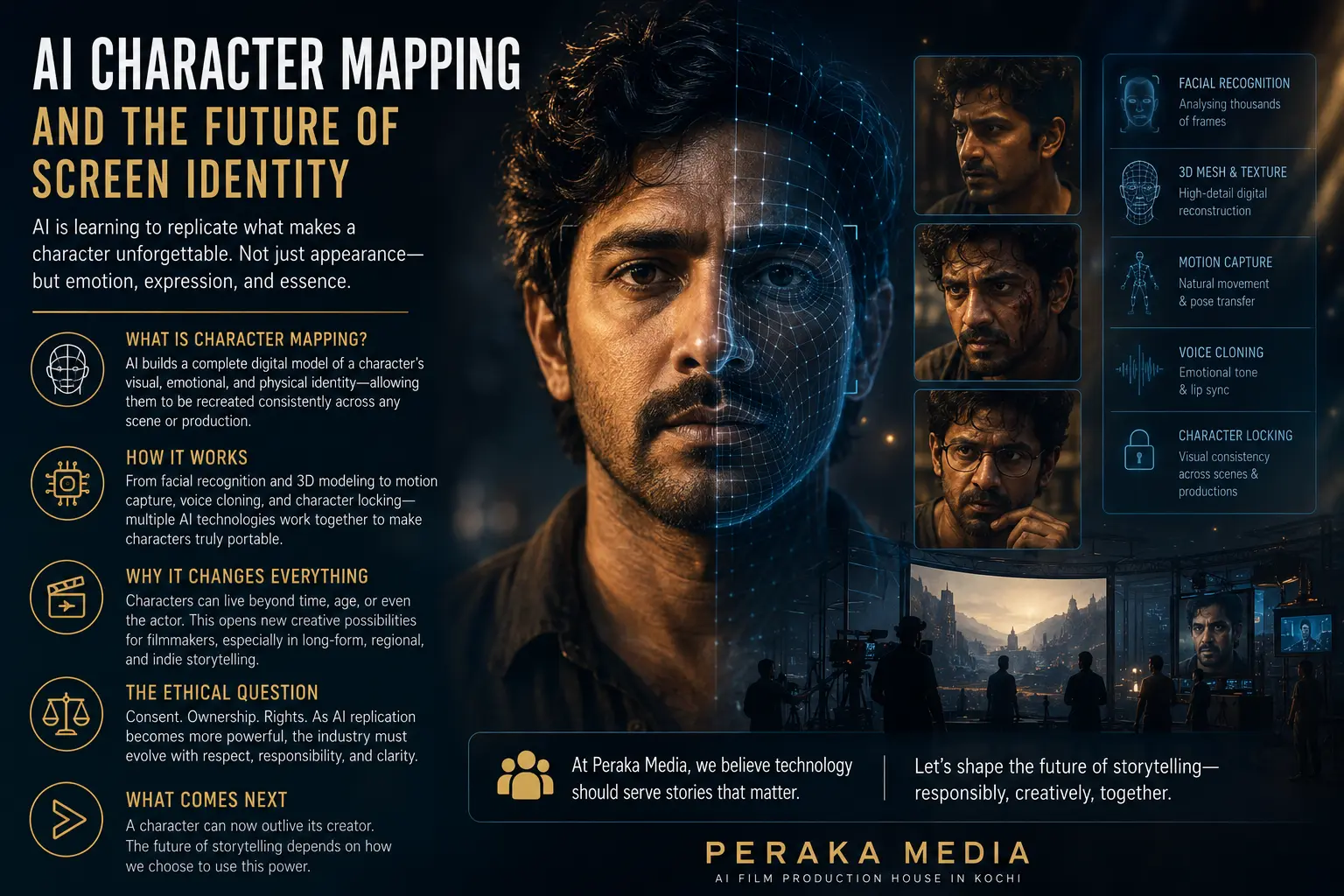
AI Character Mapping and the Future of Screen Identity
There is something almost sacred about a great screen character. The way a pair of eyes carries grief without a single word. The slight curl of a lip before a villain speaks. For decades, that magic lived entirely within the body of an actor and the irreplaceable craft of the human being behind the role.
AI is now learning to replicate it. Precisely, consistently, and at scale.
What Is Character Mapping?
AI character mapping is the process by which an artificial intelligence system builds a comprehensive digital model of a character’s visual, emotional and physical identity and then reproduces it faithfully across scenes, episodes, or entirely new productions.
The AI does not just capture what a character looks like. It captures how they look when they are afraid. How their posture shifts when they are confident. The specific warmth of their skin tone under golden-hour light. The bone structure from every angle. Once mapped, this character can be placed into any scene without the actor present and still look unmistakable.
How It Works
Facial recognition tools analyse thousands of reference frames, building a 3D mesh of the character’s face with extraordinary detail, including microexpressions that make a performance feel real. New AI architectures, including those embedded in platforms like Frameo.AI by Dashverse, now maintain visual consistency across long-form series through what engineers call character locking. Motion capture and pose transfer apply movement data with natural physics. Voice cloning maps emotional tone and syncs it to the character’s physical performance.
Together, these technologies make a character genuinely portable across time, format and production context.
Why It Changes Everything
For large franchises, a beloved character no longer has to age or be recast. For regional and independent cinema, the possibilities are even more interesting. Malayalam cinema, known for its deeply character-driven narratives, has long been dependent on the physical availability of its actors. AI character mapping opens up a different way of working, particularly for stories that move across time or demand a character at multiple stages of life.
This was used in the movie, Rekhachithram, which was released in the year 2025.
For animation and hybrid productions, the lines are dissolving entirely. Audiences are increasingly unable, and arguably unwilling, to tell the difference.
The Ethical Question
No conversation about character replication can avoid the central tension: consent, ownership and the rights of the human original. When an actor’s likeness is mapped, who owns that character going forward? Can a digitally replicated version be used without renegotiation? These questions drove part of the Hollywood strikes of 2023, and they are still being answered.
At Peraka Media, an AI film production house in Kochi working at the intersection of technology and narrative, these are not abstract debates. They are the questions that shape every project we build. Who owns the character? Who protects the performance? And how do we use these tools responsibly, in service of stories that actually mean something?
What Comes Next
There is something poetic about the idea that a character can now outlive its creator. In one sense, it is the ultimate tribute to great work, an acknowledgement that what was created was so vivid and real it deserves to persist. In another sense, it raises a question cinema has never faced before: when a character is no longer tied to a human body, who does it belong to?
That is the creative frontier of our generation. How we answer it will define what storytelling means in the decades ahead.
We at Peraka Media are here to help you scale your business through AI storytelling, together let’s produce great work.