

Why AI Microdramas Are the Most Exciting Thing Happening in Content Right Now
Fifteen minutes of your commute. A screen the size of your palm. A story that pulls you through episode after episode before you realise an hour has passed.
This is not a hypothetical. This is the microdrama, and it is quietly becoming the most significant shift in content consumption since the rise of streaming.
The Format Taking Over Mobile Screens
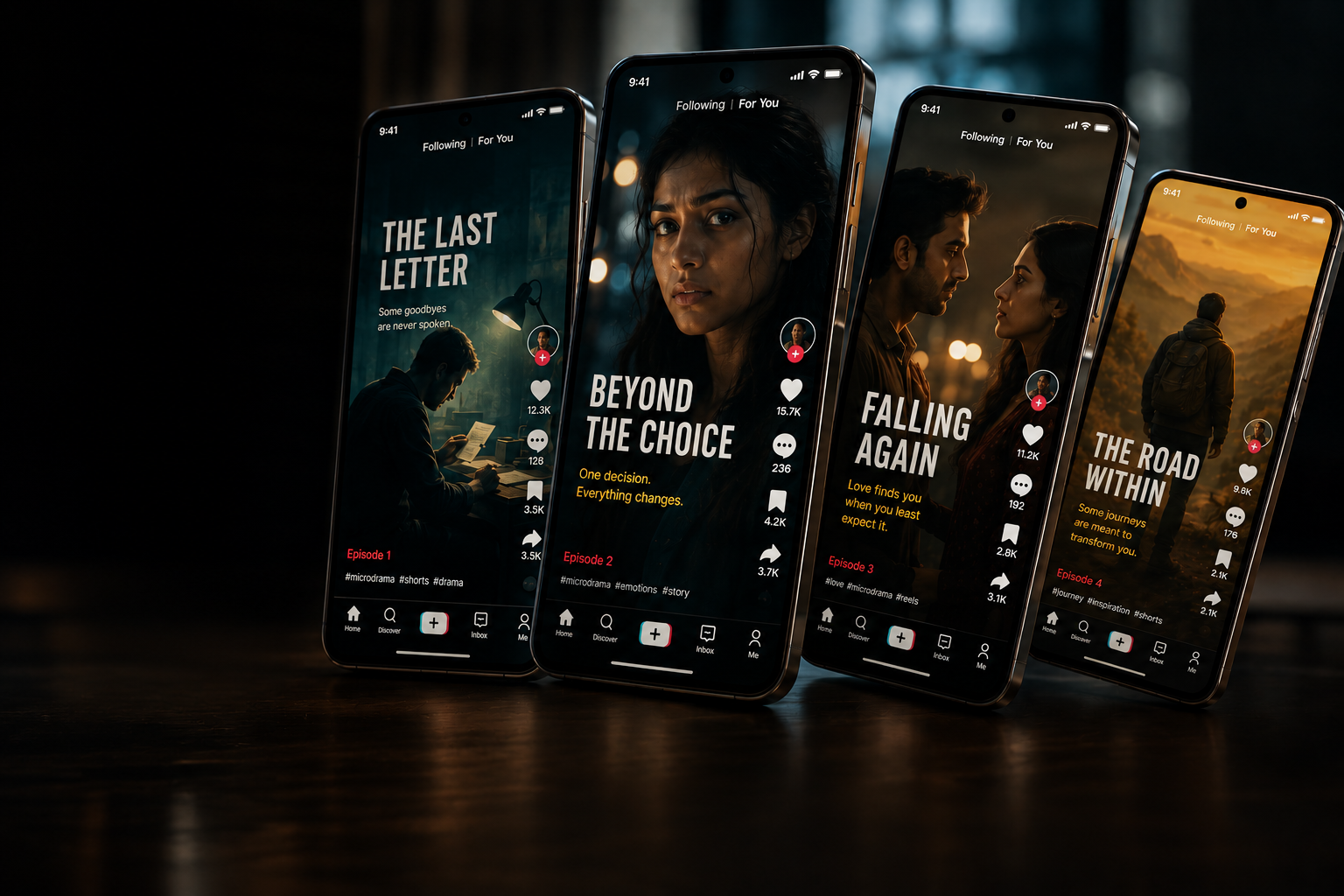
A microdrama is serialised storytelling in micro-format. Episodes run between two and ten minutes, designed for the mobile screen and the person with twenty minutes between one thing and the next. The format does not ask for your full evening. It earns the next five minutes, and then the five after that.
The format originated in China, where the microdrama market grew to billions in annual revenue before the rest of the world took notice. What is happening now, particularly in India, is something more interesting. AI is collapsing the cost and time of production so dramatically that the format is no longer the exclusive territory of well-funded studios. Individual creators, small teams, and regional storytellers are entering the space with serious content.
The Numbers Are Hard to Ignore
Dashverse, a Bengaluru-based AI entertainment company, launched India’s first fully AI-produced microdrama series in August 2025 and recorded one million views within fifteen days, with completion rates 90% above platform averages. Production costs were cut by 75% compared to traditional methods. Publisher Harlequin has since partnered with them to co-produce 40 animated microdramas for global distribution.
They are not alone. Collective Media Network has announced Historyverse, an AI-powered microdrama series on the Mahabharata. Production houses across India are experimenting with AI tools like Runway, Kling and Pika to produce short-form episodic content at speeds that were unimaginable three years ago. Globally, platforms built specifically for the microdrama format are attracting hundreds of millions of users and serious investment.
The economics are compelling for creators. A story that previously required a cast, crew, location permits, shooting schedules and a post-production pipeline can now move from script to screen in days. The barrier is no longer the budget. It is imagination and execution.
Why the Storytelling Actually Works
There is a temptation to dismiss microdramas as shallow, designed for shrinking attention spans rather than genuine emotional engagement. The completion rates tell a different story.
When a format forces every scene to earn the next two minutes of a viewer’s time, it demands tighter writing, faster character establishment and more purposeful visual storytelling. Many of the best microdramas being produced right now are not lesser versions of long-form content. They are a different discipline entirely, one that rewards creators who understand the economy of story.
What This Opens Up for Kerala
As an AI creative agency in Kochi, we have watched this shift build momentum in real time. Regional stories are finding global audiences without needing a national distributor or a satellite deal. A writer in a town with a compelling story about family, memory or place now has a direct path to a global mobile audience, if they are willing to work with the tools available.
The question is not whether AI-powered microdrama content will reach audiences. It already has. The question is whether creators will be producing it or only consuming it.
The window is open. The tools are accessible. And the audience is already waiting on the other side of a five-minute episode, ready to watch the next one.
We at Peraka Media are here to help you scale your business through AI storytelling, together let’s produce great work.