

The True Environmental Cost of AI: Balancing Innovation with Resource Consumption
Artificial intelligence is often promoted as a tool to save the planet. Tech companies use it to track deforestation, manage smart power grids, and improve weather forecasting. But AI is not an invisible, magic cloud. It is a massive physical machine made of metal, cables, and servers. While AI is helping the environment in several distinct ways, it is also draining our natural resources at an alarming rate.
The Hidden Water Cost of Every Prompt
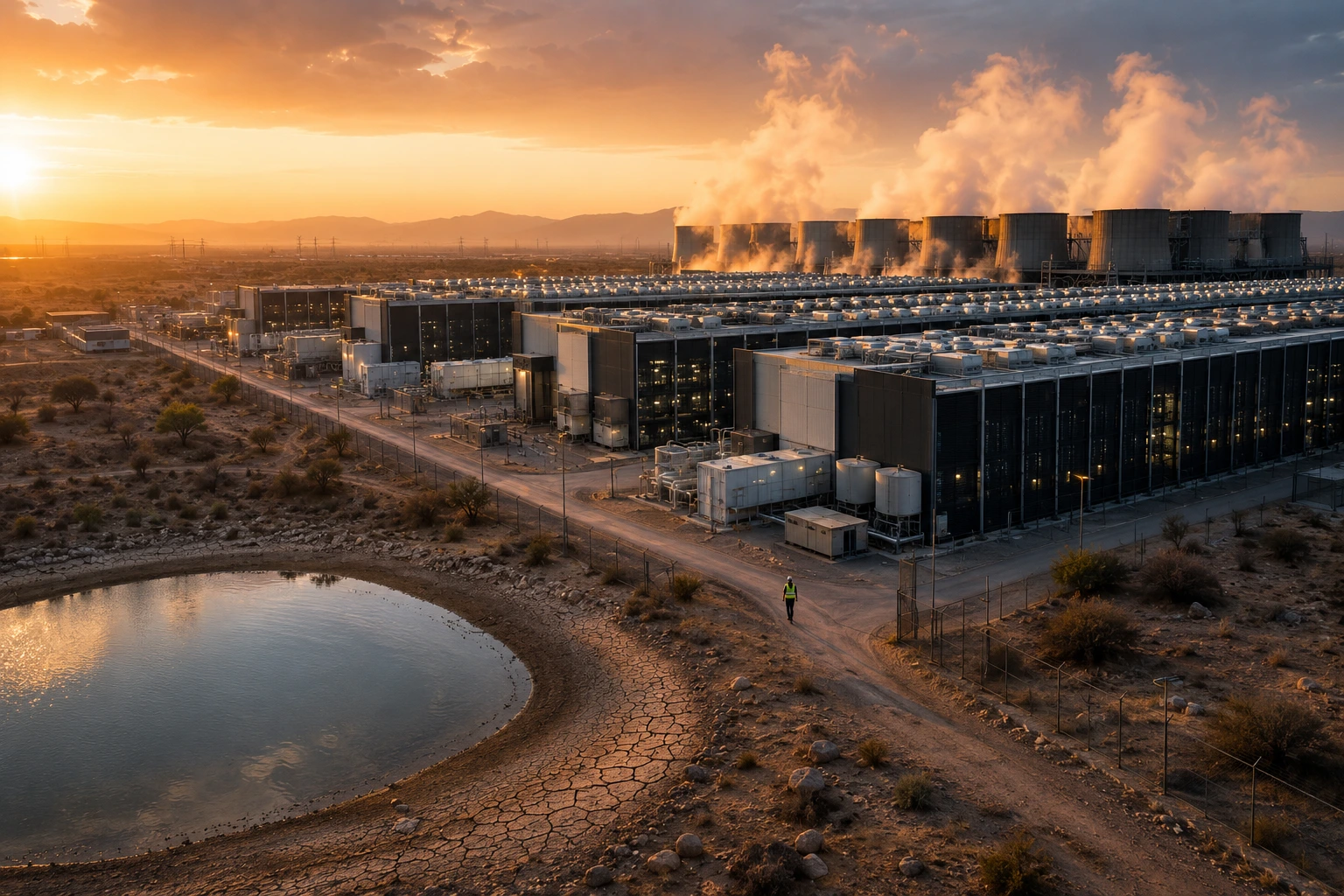
AI physically lives inside massive buildings known as data centers. Inside these buildings, thousands of servers run constantly, generating intense heat. To prevent the equipment from melting, facility managers use cooling towers that evaporate millions of gallons of fresh water.
The “One-Bottle” Rule: Every time you ask an AI a question, you use physical water.
- Writing a single 100-word email with an AI tool uses about 519 milliliters of water. That is the exact size of a standard plastic water bottle.
- A typical exchange of 10 to 50 messages costs the exact same amount of water.
- This fact comes from Making AI Less Thirsty, a major study by researchers at the University of California, Riverside.
The National Impact The scale is huge. A 2024 report by the Lawrence Berkeley National Laboratory showed the exact numbers for the United States:
- In a single year, American data centers consumed 17.4 billion gallons of water just for direct cooling.
- They used another 211 billion gallons indirectly through the power plants that make their electricity.
To make matters worse, tech firms frequently place these massive facilities in regions that already lack rain. Because of this, regular citizens end up competing directly against computer servers for their basic drinking water.
Power Drain: Energy Use and Carbon Emissions
Asking AI a question takes much more power than a normal Google search. People talk about the energy needed to build AI, but daily use is the real problem.
Daily Use Drives the Demand. A 2026 report by the United Nations found that daily AI use takes up 80% to 90% of the technology’s total energy demand.
Carbon Emissions: Because most global power still comes from fossil fuels, AI creates massive carbon emissions. The UN report stated that the yearly power used by AI created carbon emissions equal to the entire country of Argentina.
Future Power Needs: If this growth continues, data centers for AI could use 945 terawatt-hours of power a year by 2030. That is almost three times the power used by Pakistan, Nigeria, and Bangladesh combined.
Land Use and Toxic Trash
More AI means more physical machines. This takes up land and creates toxic trash.
- Land Use: Companies clear huge areas of land for new data centers. By the end of the decade, the United Nations estimates that AI server farms will cover 14,500 square kilometers of ground.
- Electronic Waste: AI computers run hot and hard, so they break down fast. By 2030, broken AI parts will create up to 2.5 million tons of electronic waste every year. This trash contains dangerous chemicals like lead and mercury, which often end up in the ground.
Why Making AI Faster Makes Things Worse
The leaders of tech companies frequently argue that future AI will save resources by burning less electricity and water per prompt. While the models do get more efficient, this actually makes the environmental problem worse.
In terms of economics, this is called the Jevons Paradox. As technology becomes cheaper and more efficient, people use it far more often. The massive increase in total users and daily prompts completely erases any energy saved by the efficiency upgrades.
The Bottom Line
AI has the power to protect our planet, but ignoring its massive physical costs is a mistake. The current pace of AI growth simply cannot last. Until tech companies switch to waterless cooling, run entirely on clean energy, and safely recycle their hardware, every single prompt we type carries a real, physical cost to the Earth.