

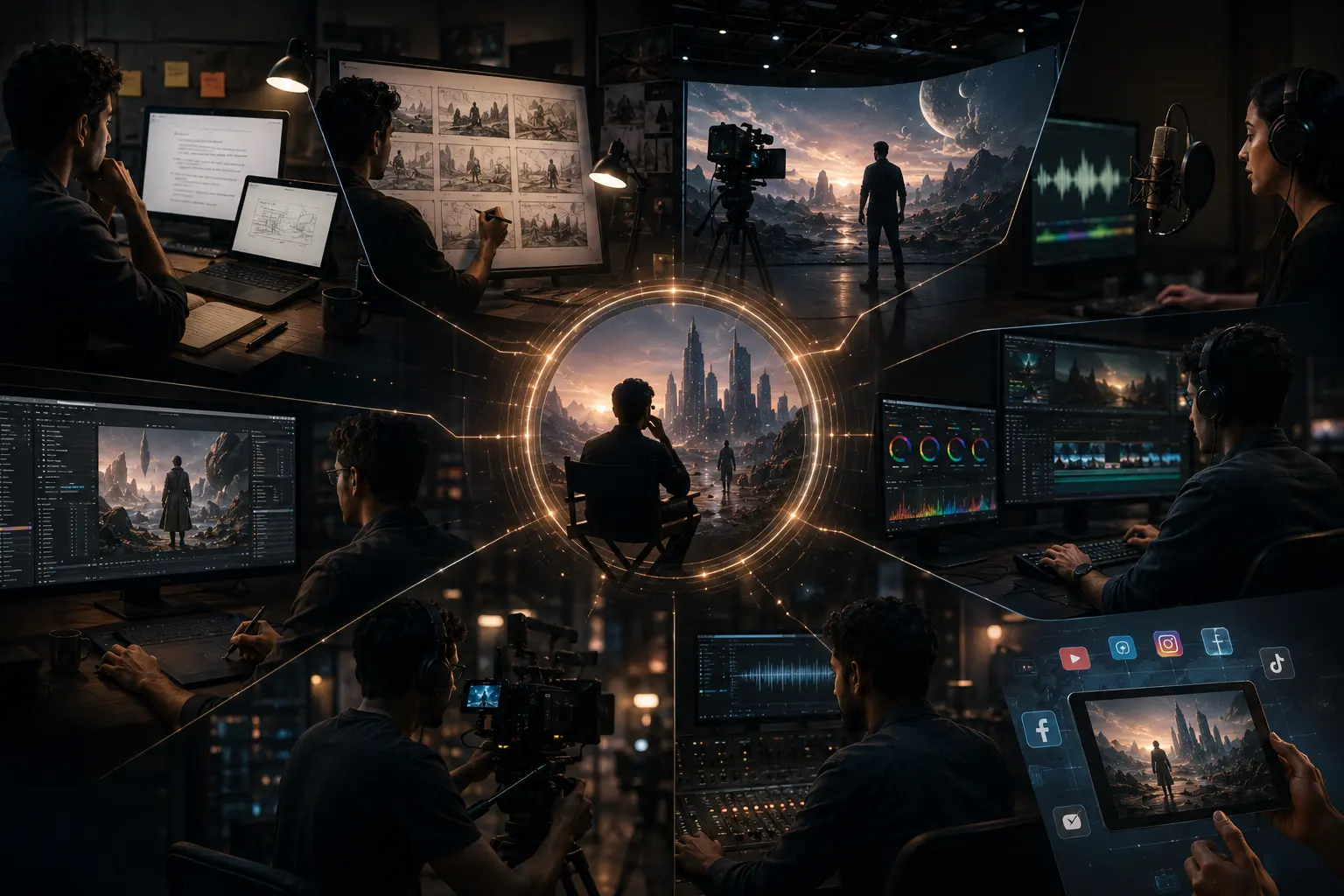
AI as a Production Engine: Rewriting How Films Get Made
The economics of filmmaking are collapsing quietly, efficiently, and irreversibly. Production is no longer defined by scale, but by systems. AI is not simply enhancing the creative process. It is restructuring the production pipeline itself. For an AI Creative Agency in Kochi, this shift is less about experimentation and more about operational advantage.
Scripting: From Blank Page to Structured Narrative
Scripting has traditionally been the slowest, most uncertain phase of filmmaking. It relies heavily on ideation, iteration, and human bandwidth. AI compresses this phase by generating structured drafts, dialogue variations, and narrative directions within minutes. It does not replace the writer’s voice, but it removes the friction of starting from zero.
This changes the nature of writing. Instead of building from scratch, writers now curate, refine, and redirect. The role evolves from creation to selection. The speed of output increases, but so does the responsibility to maintain originality. Without intervention, AI-generated scripts tend to default to predictable structures. The advantage lies in using AI to accelerate thinking, not replace it.
Pre-Production: Storyboarding and Planning
Pre-production once required extensive coordination across teams. Storyboards, shot divisions, and visual references had to be manually created and aligned. AI now enables instant visualisation of scenes through text-to-image and text-to-video tools. Concepts can be translated into visual frames almost immediately.
This reduces ambiguity. Directors and clients no longer have to imagine the outcome. They can see approximations early in the process. Decision-making becomes faster because uncertainty is reduced. For a client, this means fewer revisions later and stronger alignment at the start. Planning becomes sharper, not heavier.
Production: From Physical Sets to Generative Environments
Production has historically been the most resource-intensive stage. Locations, equipment, actors, and logistics define its scale. AI disrupts this by enabling virtual environments and synthetic elements that reduce dependence on physical setups.
Scenes that once required travel, set construction, or complex setups can now be generated or augmented digitally. This does not eliminate traditional production, but it reduces its weight. Hybrid models emerge where real footage is combined with AI-generated layers. The result is faster execution with controlled costs.
The shift is subtle but significant. Production is no longer limited by what can be physically captured. It expands into what can be computationally created.
Visual Effects: From Enhancement to Generation
Visual effects have always been about enhancement. AI moves them closer to generation. Instead of refining existing footage, AI can create entirely new visual elements that integrate seamlessly with real scenes.
Complex effects that once required large teams and extended timelines can now be executed with smaller setups and faster turnaround. Backgrounds, transitions, and stylised sequences can be generated with high consistency. This expands creative possibilities while reducing dependency on heavy post-production pipelines.
Sound and Voice: Redefining Audio Production
Sound design and voiceovers are undergoing a parallel transformation. AI can now generate voice tracks, adapt tone, and localise language without re-recording. A single script can be converted into multiple languages with consistent emotional delivery.
This is particularly valuable for scalable campaigns. Localisation becomes efficient rather than repetitive. Brands can communicate across regions without rebuilding the audio layer each time. This opens access to wider markets without increasing production complexity.
At the same time, the nuance of human performance remains critical. AI can replicate tone, but intention still requires direction. The role shifts from recording to refining.
Editing: Real-Time Assembly and Iteration
Editing has traditionally been a time-intensive process involving selection, sequencing, and refinement. AI accelerates this by automating rough cuts, suggesting shot sequences, and enabling rapid iteration.
Editors are no longer constrained by time-heavy assembly processes. They can focus on rhythm, pacing, and storytelling. Multiple versions of the same film can be generated and tested quickly. This aligns with the growing need for platform-specific content and audience targeting.
The bottleneck is no longer execution. It is decision-making. When multiple edits can be produced instantly, choosing the right one becomes the critical task.
The Shift: From Effort to Judgment
AI as a production engine does not remove the need for creativity. It removes the weight of execution. Every stage of filmmaking becomes faster, more flexible, and more scalable. But this also exposes a deeper challenge.
When production becomes easy, differentiation becomes difficult.
For a brand, the advantage will not come from using AI alone. It will come from how precisely it is used. Knowing what to automate and what to preserve becomes the defining skill. The production process is no longer the constraint, Human judgment is!