

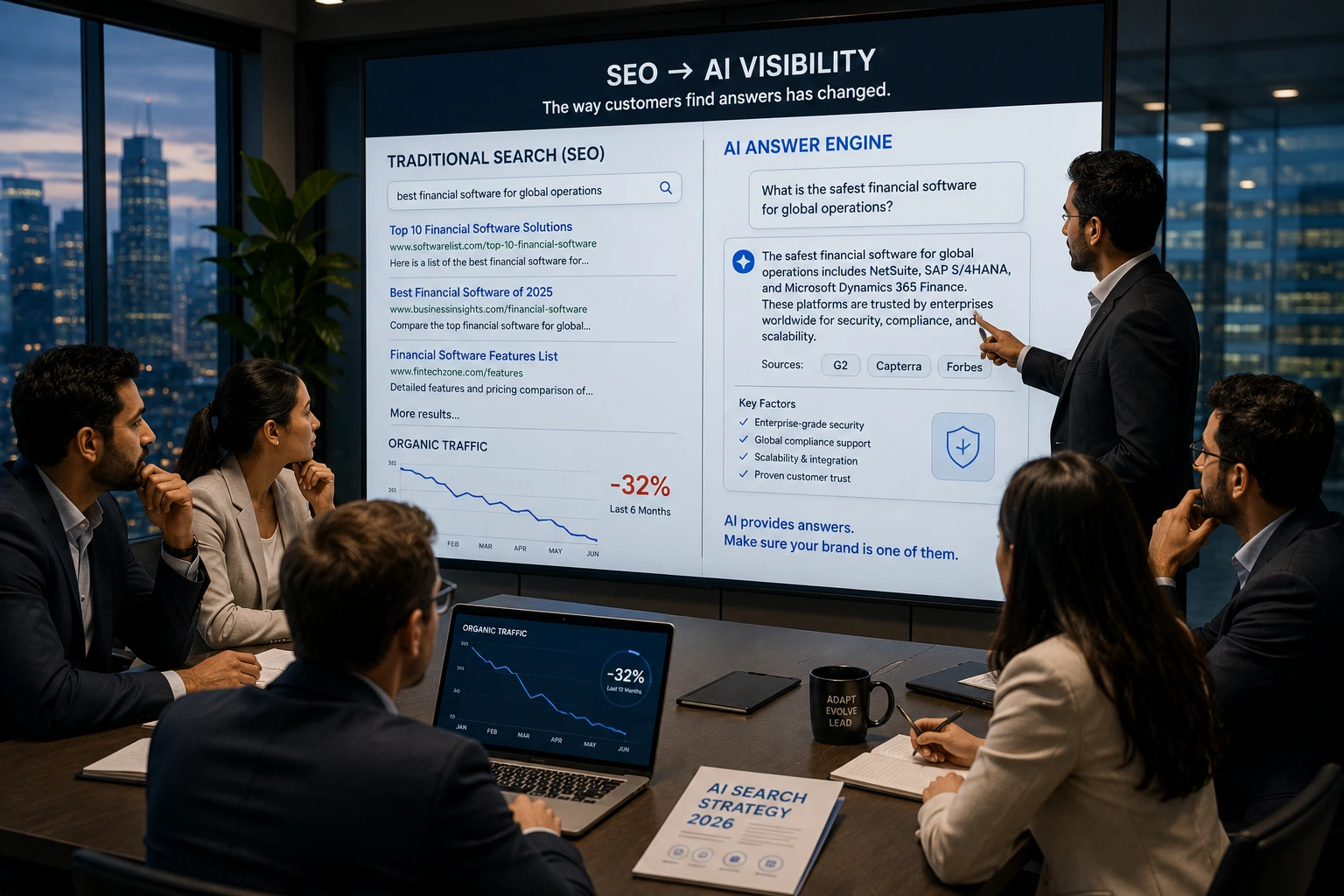
How Large Brands Must Adapt to AI Search Engines in 2026
By 2026, the way large businesses get found online has completely changed. If your company still relies on old search engine optimization (SEO) tactics, you are losing ground. Gartner expects that 40% of B2B searches will be handled entirely inside AI answer engines by 2026. Buyers do not want to click through ten blue links anymore; they want direct answers from tools like ChatGPT and Google AI Overviews.
Because of this change, big companies need to stop relying on old SEO tactics and start optimizing for AI answers. Here is the hard truth about how to adapt your strategy to ensure AI models recommend your company.
1. Stop Chasing Keywords and Start Structuring Answers
Traditional SEO was built on getting as many links as possible and repeating keywords. AI search engines do not care about that. They care about extracting clear facts to build an answer.
To win in AI search, you must change how your website is written:
- Use a Clear Structure: Organize your pages with simple, logical headings (H1, H2, H3). AI systems use these headings to understand exactly what each section covers.
- Give Direct Answers First: Put the most important information at the very top of each section. Do not bury the answer deep in a long paragraph.
- Keep It Short: Write paragraphs that are a maximum of two to three sentences. Break down long content into simple Question-and-Answer blocks of less than 300 characters. AI models struggle to read long walls of text.
2. Focus on “Fan-Out” Queries
When a buyer asks an AI a complex question, the AI breaks it down into smaller, separate searches. These are known as fan-out queries.
Consider a scenario where a user searches for “the safest financial software for global operations.”The AI might run three separate background searches for security features, bank compliance, and enterprise pricing. Your content must be detailed enough to rank for these very specific, smaller questions. Put context words like “price,” “risk,” or “timeline” directly into your text.
3. Build Authority Outside Your Website
You can have a perfectly built website, but if no one else talks about you, AI models will ignore you. AI platforms are trained on huge amounts of data from the whole internet. They learn who the market leaders are by looking for a consensus.
If you want an AI to recommend your brand, you need:
- Consistent Mentions: Get your brand discussed in comparison articles, expert reviews, and industry forums written by third parties.
- Strong Review Profiles: Ensure your company has high ratings on trusted review sites like G2 or Capterra. AI systems read these review sites to decide if your brand is trustworthy.
- A Clear Identity: Your company must have a single, clear message across all external websites. If different sites say different things about your brand, the AI gets confused and will not cite you.
4. Fix Your Technical Setup for AI Bots
If an AI bot cannot scan your site, you will not show up in the results. Many large companies block these bots by accident.
- Check Your Access: Make sure your server logs and systems (like Cloudflare) are not set to block AI bots.
- Use Schema Data: Add structured data (like FAQPage) to your site. It will not magically boost your AI rankings, but you still need it. It gives AI bots a simple map to quickly find and verify your company facts.
- Add an LLMs.txt File: Similar to a standard robots.txt file, this gives AI bots a clear, machine-readable map of your website.
The rules of search have changed. To attract large business deals, you must feed AI systems exactly what they want: clear facts, structured data, and strong outside proof.
The Bottom Line
AI search is here. If you ignore it, you will lose your traffic to competitors. You must fix your site structure, build outside proof, and let AI bots read your pages.
You need an agency that understands this shift. Peraka Media is a Kochi-based production and marketing house. We build ad films, run digital marketing campaigns, and create AI content that works.
Stop using old search tactics. Contact Peraka Media to update your strategy today.